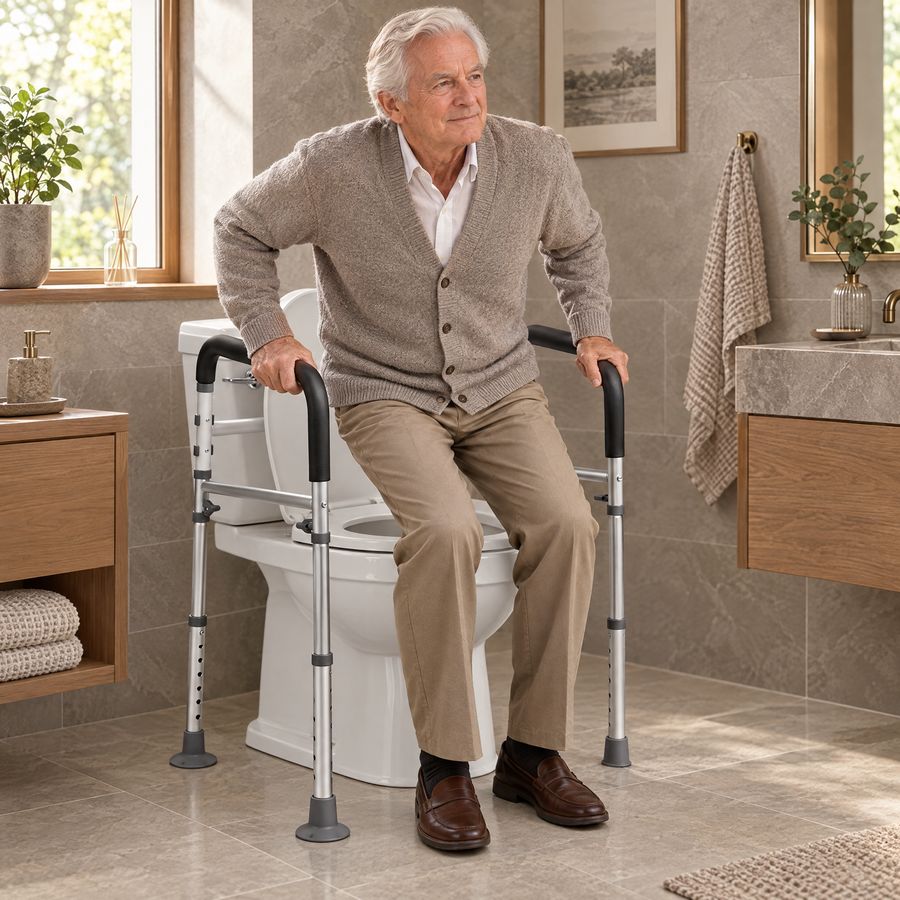
What should I do before setting it up?
Before you set up a freestanding toilet safety rail, get three things ready: the floor, the measurements and the person. The floor matters because the rail is held in place by its four suction-cup feet rather than by screws, so they need a clean, dry, flat surface. The measurements tell you roughly where to set the width and height before you start adjusting. And the person who will use the rail should be nearby, because the right height is set for their body, not guessed in advance.
- Clear the floor around the toilet and wipe it clean and dry. Suction-cup feet grip best on a clean, flat, hard floor.
- Take your measurements first. The fit guide shows roughly where the armrests will sit above the seat.
- Have the person who'll use the rail nearby. You'll want them to try it before you call it done.
How do I set up a freestanding toilet safety rail?
Unfold the frame, set the width so the bowl fits between the armrests, set all four legs to the same height so the armrests are at the person's forearm height when seated, then press the suction-cup feet flat on a clean, dry floor and do a wiggle test. No tools are needed, and it takes about ten minutes.
- Unfold the frame and lock both sides open until the catches click.
- Set the width. Slide the arms so the bowl fits between the armrests with a little room on each side. Both sides should be on the same setting.
- Set the height. Press the spring buttons on each leg and slide to a starting height. A good starting point: with the person seated, their forearms rest on the armrests with shoulders relaxed, not hunched up or reaching down.
- Check the legs match. Count the holes on all four legs. Every leg should be on the same hole, with every button fully popped through.
- Place it around the toilet so the person can sit down without turning sideways, and press all four suction-cup feet flat onto the floor.
- Do the wiggle test. Press down hard on each armrest, then push it side to side. It shouldn't rock, lift or slide. If it does, recheck the leg heights and the floor.
- Let them try it. Sit down, stand up, twice. Ask if anything feels too high, too low or too far back, and adjust one step at a time.
How high should the armrests be?
Set the armrests at the person's forearm height while they sit upright with relaxed shoulders. Measure from the seat to the bottom of their elbow, then adjust the legs until the top of each armrest sits at about that height. The Abrielder rail's armrests adjust from 25.4 to 31.3 inches above the floor in 7 settings, so on a standard 15-inch seat they sit roughly 10 to 16 inches above it. Then check it with the person: they should be able to put both hands flat on the armrests, lean forward slightly and push straight up without lifting their shoulders. If they use a raised toilet seat, set the height with the raised seat in place, because it adds several inches. Recheck whenever the seat, the bathroom or the person's mobility changes.
What is the 30-second weekly check?
Once a week, check four things, which takes about 30 seconds: every spring button is fully through its hole, the padded armrests aren't cracked or split, the suction-cup feet are clean and sitting flat, and the frame still passes the wiggle test. A freestanding rail stays put because of its feet and its height pins, not screws, so the problems to catch early are small ones: a button that has slipped halfway out, or a foot that has picked up soap and lost its grip. If anything looks wrong, stop using the rail until it's fixed.
- All spring buttons still fully through their holes
- No crack or split in the padded armrests
- Suction-cup feet clean, seated and flat (soap and water is enough)
- The wiggle test still passes
When should I adjust it again?
Adjust it after a new raised seat, a move to a different bathroom, or any change in health or in how the person moves. Small changes in strength often mean the best height changes too. An occupational therapist can watch them use it and suggest the right setting.
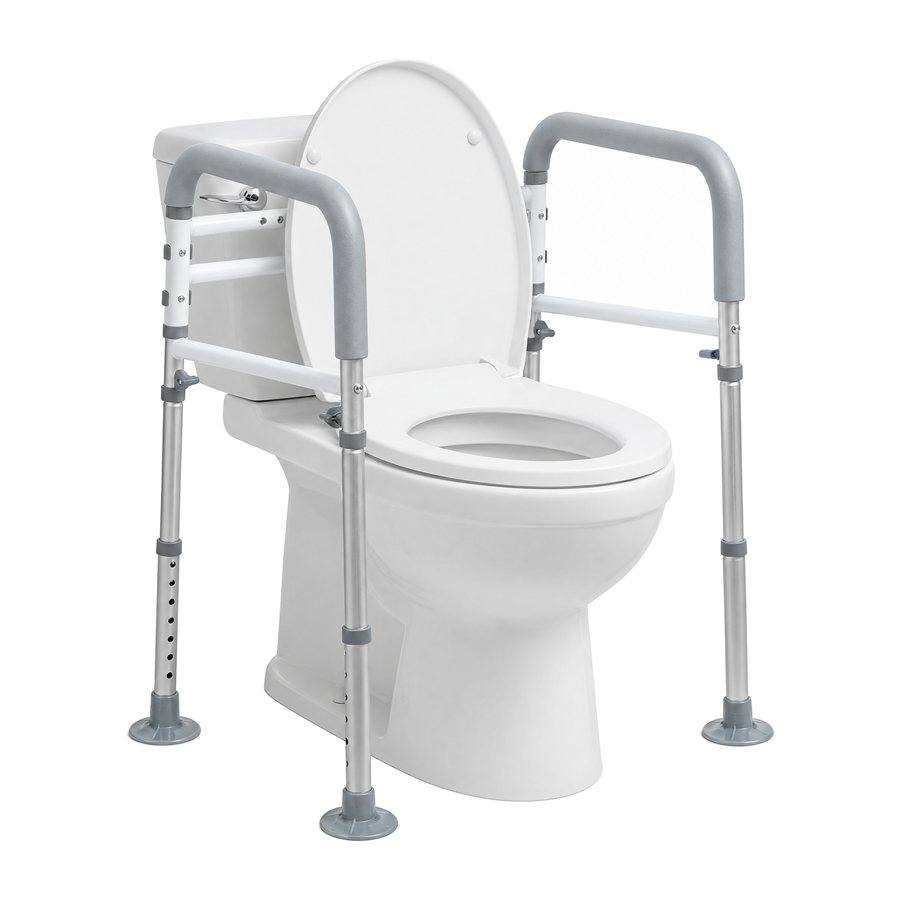
Height adjusts in 7 steps. Four suction-cup feet. No tools, no drilling.
Written by Arman Markar, founder of Abrielder. General information only, not medical advice.
← Will a toilet safety rail fit my toilet? · Next: bed rail or bed assist handle? →