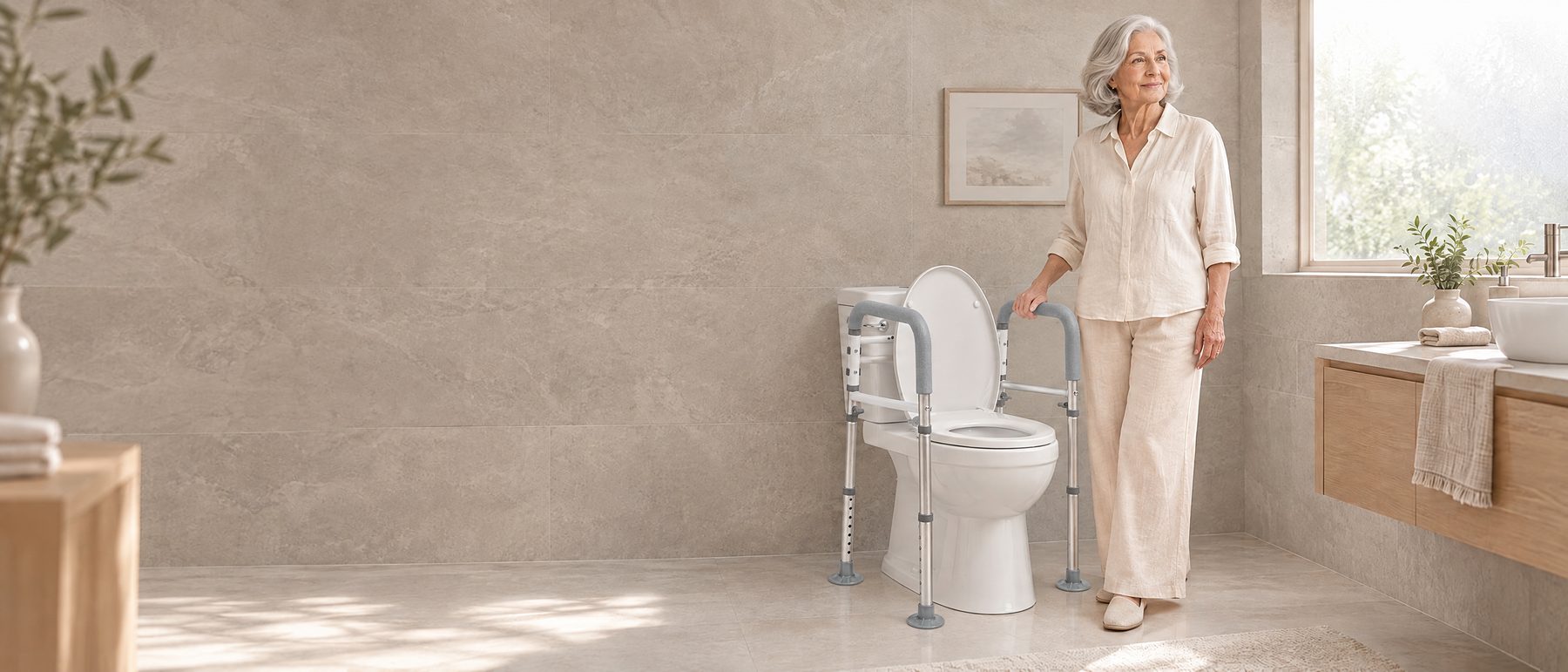
Age gracefully.
A freestanding toilet safety rail with two padded armrests, so the people you love can sit and stand on their own. No tools, no drilling, sold on Amazon.
Something solid to hold, on both sides.
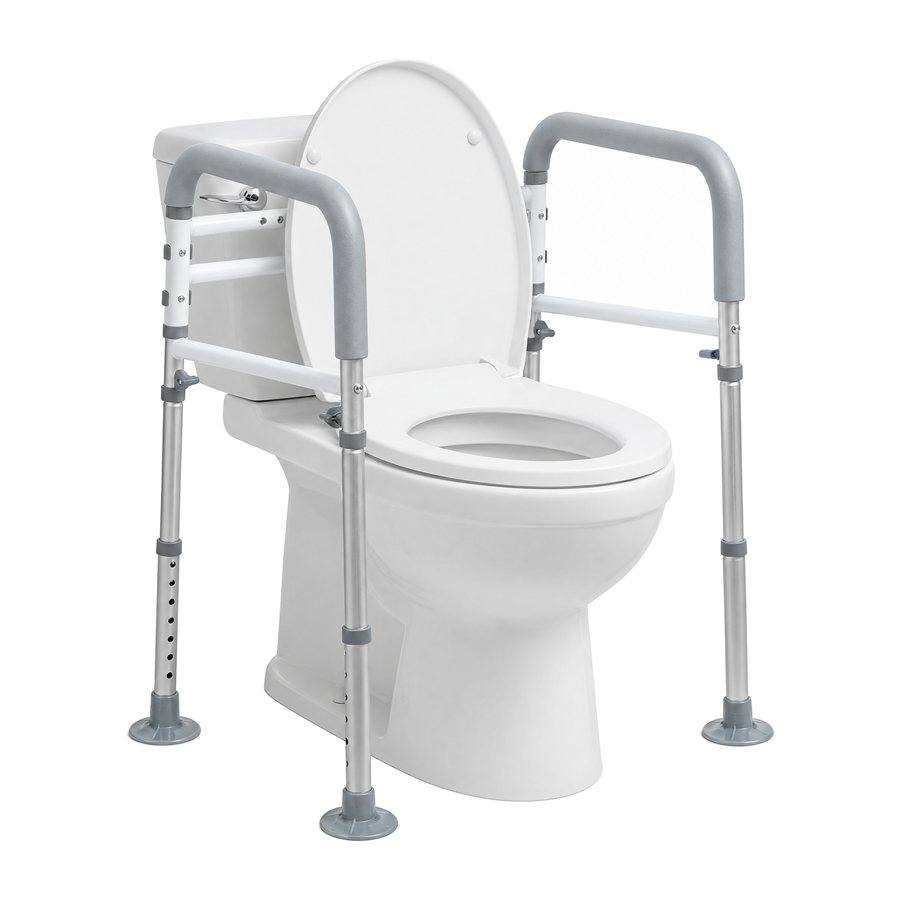
Sitting down and standing up take the most strength in a bathroom, often on a slippery floor with nothing to hold. The Abrielder toilet safety rail is a freestanding aluminium frame with two light grey padded armrests. It stands around the toilet on four suction-cup feet, so it gives a firm push-off point on both sides at a height you choose, with nothing drilled into the floor or walls.
| Frame | Aluminium, white bars, silver legs |
|---|---|
| Armrests | Two, light grey padded foam |
| Armrest height from floor | 25.4–31.3 in (64.5–79.5 cm), 7 settings |
| Feet | Four suction-cup feet |
| Fits | Most standard and elongated toilets |
| Frame weight | 2.65 kg (5.8 lb) |
| Setup | Tool-free, no drilling; folds flat |
| Price | $59.99 on Amazon US (October 2026) |
Check your bathroom with the fit guide before you buy, and see the Amazon listing for the frame's outside dimensions.

Getting up without calling for help.
Using your own bathroom at three in the morning.
Staying in the house where the photos are.
Dignity lives in small, ordinary moments. Abrielder makes a short list of well-built supports for them, and explains plainly how to choose and set each one up.
Measure once, buy with confidence.
Will a toilet safety rail fit my toilet?
Round or elongated, tight corners, raised seats. The measurements to take and a quick height checker.
How do I set up a toilet safety rail at the right height?
Tool-free setup step by step, the right armrest height for the person using it, and a 30-second weekly check.
Bed rail or bed assist handle: what's safe?
The US safety standard for adult bed rails, the gaps that matter, and questions to ask before you buy.
Toilet safety rail or raised toilet seat: which one do you need?
A raised toilet seat adds height; a toilet safety rail adds something to hold. How to tell which your parent needs, and how to use both together.
Toilet safety rail or grab bar: which is better?
Freestanding toilet safety rail or wall-mounted grab bar? How they differ, when each suits, what fixing a grab bar takes, and options for renters.
Standard, comfort-height or raised: which toilet seat height is right?
Standard, comfort-height and raised toilet seats compared: typical heights, how to measure, when a raised seat helps, and how armrest rails pair with them.
Why does my toilet safety rail slide, and how do I stop it?
Why a freestanding toilet safety rail slides or wobbles: floor type, dirty suction-cup feet, uneven legs. Step-by-step fixes and when to stop using it.
How to clean and care for a toilet safety rail
How to clean an aluminium toilet safety rail and its padded armrests, keep suction-cup feet gripping, check it weekly, store it folded and replace worn parts.
How do I make a bathroom safer for an older parent?
A zone-by-zone bathroom checklist for families: floor, toilet, shower or tub, lighting, reach, door lock and calling for help. Most of it needs no renovation.
Bathroom safety for renters: what you can add without drilling
What renters can add to a bathroom without drilling: freestanding toilet rails, raised seats, shower chairs, mats and night lights, and when to ask the landlord
Safer night-time bathroom trips: lighting, paths and setup
How to set up the route from bed to toilet for a parent who gets up at night: lighting they can reach, a clear path, what to keep by the bed, and the toilet.
Getting the home ready when a parent comes home from the hospital
Practical home prep for a parent coming home from the hospital: who to ask, clear paths, bathroom and bed setup, lighting and keeping essentials within reach.
How to talk to a parent about bathroom safety aids
How to raise bathroom safety aids with an older parent with dignity: framing, choosing together, trial periods, siblings and when to ask their doctor.
Toilet safety rail FAQ
How do I choose a toilet safety rail?
Start with three measurements: the widest point of the toilet bowl, the clear floor space around the toilet, and the seat height. A freestanding rail suits renters and anyone who can't drill. Choose one whose armrests can reach the person's forearm height when seated, with feet that grip a flat, dry floor.
Is a toilet safety rail or a grab bar better?
A grab bar is fixed to the wall and gives one handhold to the side. A freestanding toilet safety rail gives two armrests, one on each side, so the person can push up evenly with both hands. Rails need no drilling and can move between bathrooms; grab bars need solid wall fixings.
Will the Abrielder toilet safety rail fit an elongated toilet?
It fits most standard (round) and elongated toilets, because it stands on the floor around the toilet instead of bolting to it. Before buying, measure the clear floor width around the toilet and compare it with the frame's outside dimensions on the Amazon listing.
How high should toilet safety rail armrests be?
Set them so that, seated, the person's forearms rest on the armrests with relaxed shoulders. Too low and they bend forward and strain their wrists; too high and their elbows lift. The Abrielder rail's armrests adjust from 25.4 to 31.3 inches above the floor in 7 settings.
Can I use a toilet safety rail with a raised toilet seat?
Usually, yes. A raised seat typically adds 3 to 5 inches, so set the rail with the seat in place and check the armrests can still reach the person's forearm height when seated. Our fit guide has a quick height checker for this.
Do I need tools or drilling to set up the Abrielder rail?
No. The frame unfolds, the legs adjust with spring buttons, and it stands on four suction-cup feet. Nothing is screwed into the floor or walls, which makes it a common choice for renters.
How do I stop a toilet safety rail from sliding?
Wipe the floor clean and dry, press each suction-cup foot down flat, and make sure all four legs are on the same height setting. Then press down hard on each armrest and push it side to side. If it rocks or slides, recheck the legs and the floor.
Where can I buy the Abrielder toilet safety rail?
It is sold on Amazon.com in the United States (ASIN B0FJFM5K8H) and shipped by Amazon. Abrielder does not sell directly on this website.
We're working on a bed rail.
An Abrielder bed rail is in development. It is not for sale, and we won't sell it until it meets the US safety standard for adult portable bed rails, 16 CFR 1270.
Until then, our bed rail safety guide explains what to look for in any bed rail.
One email if it launches. See our privacy policy.
The Home Safety Checklist
One page you can walk through room by room in twenty minutes. Made for adult children helping a parent stay at home.
Email is optional. See our privacy policy.
- Bathroom: rails, floor grip, the height of the seat
- Bedroom: getting in and out of bed, a light within reach
- Hallways and stairs: clear paths, loose rugs, night lighting
- Kitchen: what's stored too high or too low
- Phones and help: who gets called, and how