What is the difference between a toilet safety rail and a grab bar?
A grab bar is a single bar screwed into the wall, usually beside or behind the toilet. A toilet safety rail is a frame that stands on the floor around the toilet with an armrest on each side. The grab bar is permanent, takes up almost no floor space and gives one fixed hold on one side. The freestanding rail needs no drilling, gives a hold on both sides and can be moved or folded away, but it takes up floor space and depends on a flat, clean floor. Which suits you depends on the walls, the floor and whether you own the home.
| Wall-mounted grab bar | Freestanding toilet safety rail | |
|---|---|---|
| How it's held | Screwed into the wall | Stands on the floor |
| Where you hold | One side | Both sides |
| Installation | Drill and fixings, often a professional | No tools, no drilling |
| Floor space | Almost none | Room on both sides of the toilet |
| Height | Fixed once installed | Adjustable |
| Renting | Needs landlord permission | Nothing fixed to the property |
| Moving it | Leaves holes to repair | Fold and take it with you |
When is a wall-mounted grab bar the better choice?
A wall-mounted grab bar is usually the better choice when you own the home, there is a solid wall within easy reach of the toilet, and your parent mainly needs one firm hold to steady themselves. Installed properly, it stays put with nothing to adjust and leaves the floor clear for a walker and for cleaning. The CDC's home safety advice for older adults includes adding grab bars next to the toilet, as well as inside and outside the tub or shower. In a narrow bathroom where a frame would crowd the space, a grab bar is often the neater answer.
- You own the home, or have written permission to drill.
- There is a wall beside the toilet, within comfortable reach from the seat.
- The bathroom is tight, or your parent uses a walker that needs the floor clear.
- Your parent has a stronger side and is comfortable pushing up with one hand.
When is a freestanding toilet safety rail the better choice?
A freestanding toilet safety rail is usually the better choice when you can't or don't want to drill: you rent, the wall beside the toilet is tiled over backing you can't check, or there is no wall within reach because the toilet sits between a vanity and a tub. It gives an armrest on each side, so your parent can push up evenly with both arms, and its height adjusts to the person. It sets up in minutes, moves to another bathroom, and folds flat. It does need a flat, firm, clean floor and enough width on both sides of the toilet.
The Abrielder Toilet Safety Rail is this type: an aluminium frame weighing 2.65 kg (5.8 lb), white bars and silver legs, two light grey padded armrests that adjust from 25.4 to 31.3 inches above the floor in 7 settings, and four suction-cup feet. It fits most standard and elongated toilets. Before buying any freestanding rail, take the three measurements in the fit guide, then follow the setup guide to set the height for your parent.
Do grab bars need to go into wall studs?
Yes, or into something equally solid. A grab bar has to be anchored to something that can take a person's full pull and push, which usually means screwing into wall studs or solid blocking behind the wall, or using fixings that the grab bar's maker approves for that wall type. Drywall alone is not enough, and tile over backing you can't see needs care. Follow the manufacturer's installation instructions exactly, and if you're not sure what's behind the wall, use a qualified installer. A towel rail is not a substitute: MedlinePlus advises not to use towel racks as grab bars, because they can't support your weight.
- Find the studs with a stud finder before choosing the position, not after.
- Use the screws and anchors the grab bar's maker specifies for your wall.
- Once installed, pull and push on it firmly before your parent uses it.
- Check it now and then for any movement or cracks in the tile or grout around the fixings.
Can renters install a grab bar by the toilet?
Usually only with the landlord's agreement, because drilling into walls or tile is a change to the property. Under the federal Fair Housing Act, a landlord must generally allow a tenant with a disability to make a reasonable modification such as installing grab bars in the bathroom, but the tenant pays for it, and the landlord can reasonably ask for the grab bars to be removed at move-out (HUD and DOJ joint statement). Ask in writing before anything is drilled, and keep the reply. If you would rather not drill at all, a freestanding toilet safety rail leaves the walls untouched.
The renters' guide covers the other no-drill options for the bathroom, from raised seats to night lights, and what to include in a request to your landlord.
Should you use a toilet safety rail and a grab bar together?
Sometimes. They do different jobs, so they can work side by side: the rail around the toilet for sitting and standing with both arms, and a grab bar on the wall where your parent turns, walks to the sink or steps toward the shower. What to avoid is clutter. Check that the rail's frame doesn't sit under the grab bar in a way that forces an awkward reach, and that the walking route through the bathroom stays clear. If you're unsure where each should go, an occupational therapist can look at the room and how your parent moves and suggest positions.
The bathroom is worth the attention. The CDC reports that more than one out of four older people falls each year, and its prevention advice names the area next to the toilet as one of the places to add support.
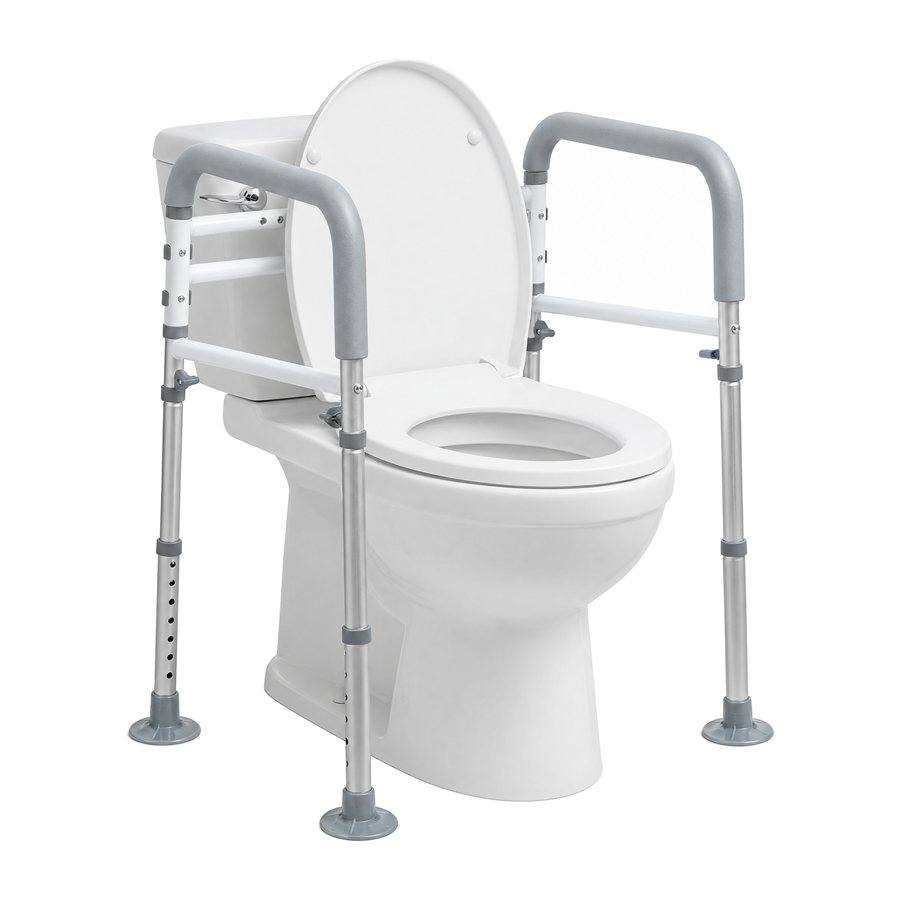
Freestanding, so nothing goes into the walls. Armrests adjust in 7 heights. Folds flat.
Sources
- Older Adult Falls Data, Centers for Disease Control and Prevention
- Preventing Falls and Hip Fractures, Centers for Disease Control and Prevention
- Bathroom safety for adults, MedlinePlus Medical Encyclopedia, U.S. National Library of Medicine
- Joint Statement of HUD and the Department of Justice: Reasonable Modifications Under the Fair Housing Act (2008)
Written by Arman Markar, founder of Abrielder. General information only, not medical advice.
Toilet safety rail or raised toilet seat? · Bathroom safety for renters · Will a rail fit my toilet? · Setup guide