What bathroom safety equipment can renters add without drilling?
Most of the useful equipment for helping an older parent in the bathroom either stands on its own or sits on fixtures that are already there. Around the toilet, that means a freestanding toilet safety rail or a raised toilet seat. In the tub or shower, a shower chair, a tub transfer bench, and non-slip mats or decals. On the way there at night, plug-in or battery night lights. None of these need holes in the walls, and all of them can move with you. The main item that does need drilling is a proper wall-mounted grab bar.
| Item | What it does | Drilling? |
|---|---|---|
| Freestanding toilet safety rail | Armrests on both sides of the toilet | No |
| Raised toilet seat | Less distance to sit and stand | No |
| Shower chair or bath bench | Sit while washing | No |
| Tub transfer bench | Sit and slide across the tub edge | No |
| Non-slip mats or decals | Grip underfoot in the tub and outside it | No |
| Night lights | Light the route to the bathroom | No |
| Suction-cup grab handle | A handle held on by suction | No, but see below |
| Wall-mounted grab bar | A fixed hold on the wall | Yes, ask the landlord |
Are suction-cup grab bars safe to rely on?
Treat them with caution. A suction-cup grab handle holds only as long as its seal does, and the seal depends on a smooth, flat, non-porous surface, such as a single large tile with no grout line underneath. Textured tile, grout, curved fibreglass or a little soap residue can all weaken the seal, sometimes with no visible sign. If you use one, read what its maker says it is designed for and follow that, check the seal every time before use, and don't treat it as a replacement for a grab bar that is properly anchored into the wall.
What can you add around the toilet without drilling?
Two things, used alone or together: a freestanding toilet safety rail and a raised toilet seat. A freestanding rail stands on the floor around the toilet and gives an armrest on each side to hold while sitting down and pushing up, which can make both easier. A raised toilet seat sits on the bowl and adds height, so there is less distance to lower down. Neither needs anything screwed into the wall, and both come out when you move. If your parent needs both height and something to hold, set the rail's height with the raised seat already in place.
The raised seat or rail guide explains how to tell which one your parent needs. If you choose a rail, the Abrielder Toilet Safety Rail is freestanding with an aluminium frame weighing 2.65 kg (5.8 lb), two light grey padded armrests that adjust from 25.4 to 31.3 inches above the floor in 7 settings, and four suction-cup feet. It sets up without tools, folds flat for a move, and fits most standard and elongated toilets. Check your toilet with the fit guide first.
What can you add in the tub or shower without drilling?
A shower chair or bath bench lets your parent sit while washing, and a tub transfer bench straddles the side of the tub so they can sit down outside it and slide across instead of stepping over. Add non-slip suction mats or rubber decals in the bottom of the tub, a non-skid bath mat outside it, and keep the floor outside the tub or shower dry. MedlinePlus includes sitting on a bath chair or bench when showering, non-slip mats or decals in the tub and a non-skid mat outside it in its bathroom safety advice for adults.
- Lift and rinse suction mats regularly so they don't trap soap and mildew underneath.
- Replace a mat if its suction cups go stiff, curl or stop gripping.
- Place soap and shampoo where your parent can reach them without standing up or twisting.
- A handheld shower head that screws onto the existing shower arm can make seated washing easier. Keep the original to refit when you leave.
How can you make a rented bathroom easier to use at night?
Light the route, not just the room. Plug-in night lights along the path from the bedroom to the bathroom, a battery motion-sensor light that comes on as your parent walks in, and a lamp they can switch on from bed all work without wiring or drilling. The CDC's advice to older adults includes making sure the home has plenty of light by adding more or brighter bulbs, which in a rental can be as simple as swapping the bulbs in existing fittings. It also advises getting rid of things you could trip over, so keep rugs and cords off the route.
- Walk the route from bed to toilet yourself with the lights off, and note any dark stretch.
- Choose night lights with a warm, soft light that's bright enough to see the floor.
- Put a light where your parent can reach it before they stand up from bed.
Do you need landlord permission to install grab bars?
Yes, ask first. Drilling into walls or tile is a change to the property, so get your landlord's agreement in writing before anything is fixed. Under the federal Fair Housing Act, a landlord must generally allow a tenant with a disability to make reasonable modifications such as installing grab bars in the bathroom, at the tenant's expense, and can reasonably ask for the grab bars to be removed when the tenant moves out (HUD and DOJ joint statement). State and local rules can add to this, and federally assisted housing has its own rules, so check with your landlord or a local fair housing organization.
- Put the request in writing. Say what you want to install and where.
- Explain the need. Say briefly how the change relates to your parent's needs.
- Offer a professional install and say who will do it.
- Agree on move-out in advance: whether the bars stay or come out, and how holes will be repaired.
- Keep the reply with your lease.
It is worth the conversation. In a CDC analysis of bathroom injuries among people aged 15 and older treated in US emergency departments in 2008, falls were the most common primary cause, at 81.1% (CDC MMWR, 2011). For the wider choice between fixed and freestanding support, see toilet safety rail or grab bar.
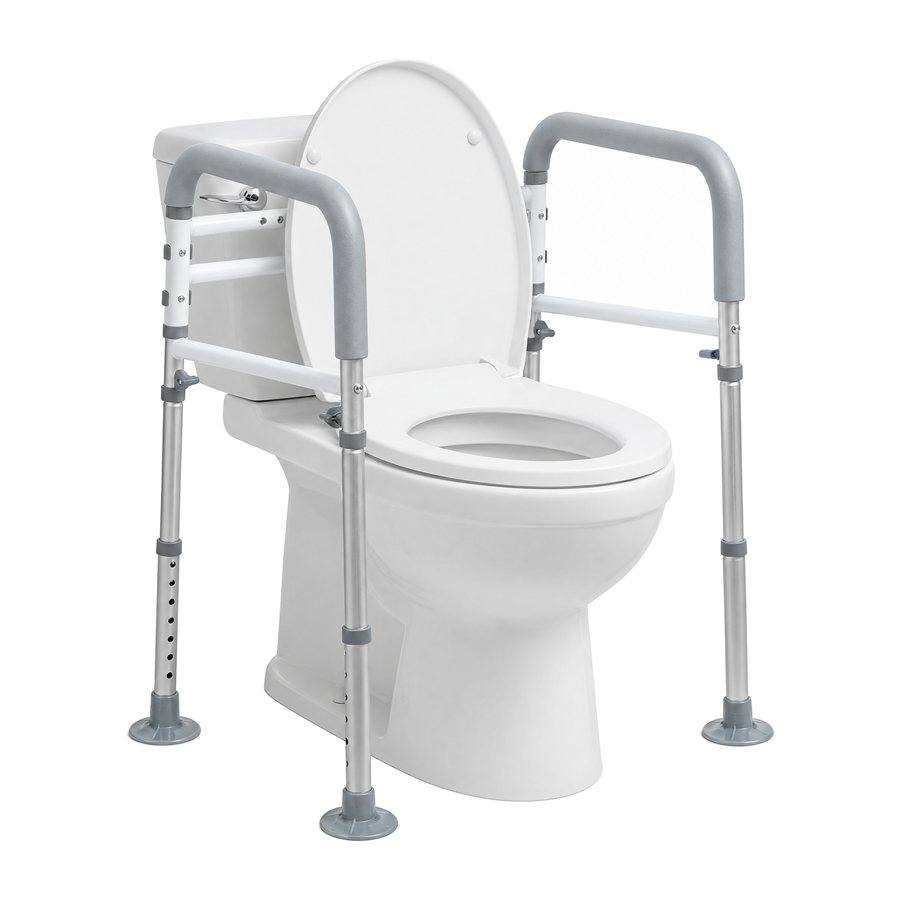
Freestanding, so nothing goes into the walls. Tool-free setup, folds flat, and goes with you when you move.
Sources
- Preventing Falls and Hip Fractures, Centers for Disease Control and Prevention
- Nonfatal Bathroom Injuries Among Persons Aged ≥15 Years, United States, 2008 (MMWR, CDC, 2011)
- Bathroom safety for adults, MedlinePlus Medical Encyclopedia, U.S. National Library of Medicine
- Joint Statement of HUD and the Department of Justice: Reasonable Modifications Under the Fair Housing Act (2008)
Written by Arman Markar, founder of Abrielder. General information only, not medical advice.
Toilet safety rail or grab bar? · Toilet safety rail or raised toilet seat? · Will a rail fit my toilet? · Setup guide