What is the difference between a raised toilet seat and a toilet safety rail?
A raised toilet seat changes the height of the seat, while a toilet safety rail adds something to hold. A raised seat sits on or clamps to the bowl and typically adds about 3 to 5 inches, so the person has less distance to lower down and push up from. A toilet safety rail is a frame that stands around the toilet with an armrest on each side, so the person can steady themselves on the way down and push up with their arms on the way up. One deals with a height problem, the other with a support problem. Some raised seats come with built-in arms, which combine a little of both.
| Raised toilet seat | Toilet safety rail | |
|---|---|---|
| What it changes | Seat height | Adds armrests to hold |
| How it's held | Sits on or clamps to the bowl | Stands on the floor around the toilet |
| Floor space | None extra | Needs room on both sides |
| Something to hold | Only if it has arms | Yes, on both sides |
| Other people using the toilet | Everyone sits higher | Others can use the toilet as normal |
| Use with the other | Yes | Yes, set the height with the seat in place |
When is a raised toilet seat the better choice?
A raised toilet seat is usually the better first step when the main difficulty is how low the toilet is. The signs are that your parent gets up from a dining chair without much trouble but struggles to get off the toilet, or that bending deeply at the hips and knees is uncomfortable. A raised seat also adds nothing to the floor space around the toilet, which matters in a small bathroom. MedlinePlus lists a raised toilet seat or a commode chair among its bathroom safety suggestions for adults. The trade-off is that a seat on its own gives nothing to hold, and everyone else using that toilet sits higher too.
- Choose a seat made for your toilet's shape, round or elongated. The fit guide shows how to tell which you have.
- Check that it locks or clamps firmly and doesn't shift when someone sits down off-centre.
- Measure the new seat height with the raised seat in place. You'll need that number if you add a rail later.
When is a toilet safety rail the better choice?
A toilet safety rail is usually the better choice when the seat height is fine but your parent needs something solid to hold. The signs are that they push on the sink, the towel rail or their own knees to get up, or that they lower themselves unsteadily and land heavily. The armrests give both hands a place to steady on the way down and to push from on the way up, which can make sitting and standing easier. A freestanding rail needs no drilling, so it also suits renters and bathrooms where there is no wall beside the toilet. It does take up floor space on both sides, so measure first.
The Abrielder Toilet Safety Rail is one example of the freestanding kind: an aluminium frame weighing 2.65 kg (5.8 lb), two light grey padded armrests that adjust from 25.4 to 31.3 inches above the floor in 7 settings, and four suction-cup feet. It sets up without tools, folds flat and fits most standard and elongated toilets.
Can you use a raised toilet seat and a toilet safety rail together?
Yes, and for many families that is the setup that works best. The raised seat reduces how far your parent has to lower down, and the rail gives them something to hold on both sides. The one thing to get right is the order: fit the raised seat first, then set the rail's armrests with the seat in place, because a raised seat adds several inches and changes where your parent's forearms rest. Also check that the raised seat's shape and any brackets don't get in the way of the rail's frame, and that your parent can still sit centred without turning sideways.
- Fit the raised seat and check it sits firmly on the bowl.
- Measure the new seat height from the floor to the top of the raised seat.
- Set the rail's armrests at your parent's forearm height while seated. The setup guide walks through it.
- Check both together. Press down on each armrest and on the seat. Nothing should rock, lift or slide.
- Let your parent try it a couple of times and adjust one step at a time.
As a worked example: on a standard 15-inch toilet with a raised seat that adds 4 inches, the seat sits at 19 inches. The Abrielder rail's armrest range of 25.4 to 31.3 inches from the floor would then put the armrests about 6.4 to 12.3 inches above the seat. Seats vary, so measure your own.
Is a toilet safety frame the same as a toilet safety rail?
Mostly, yes. “Toilet safety frame”, “toilet safety rail”, “toilet surround” and “toilet rails” are all used for the same kind of product: a frame with two armrests that stands around the toilet or attaches to it. The real differences are in how each one is held in place. Some stand freely on the floor, some bolt on through the toilet seat's hinge holes, and some have their own seat so they can be used over the toilet or on their own as a commode. When you compare listings, look past the name to how it attaches, the armrest height range and whether it fits your toilet.
- Freestanding frame or rail. Stands on the floor around the toilet, with no tools and nothing bolted to the toilet. The Abrielder rail is this type.
- Seat-mounted arms. Fixed under the toilet seat using the seat's own hinge bolts.
- Frame with a seat. Sometimes sold as a toilet safety frame with seat or a commode. Has its own seat and can be used over the toilet or elsewhere.
- Raised seat with arms. A raised toilet seat with armrests built in, so height and support come as one piece.
How do I decide which one my parent needs?
Watch your parent use the toilet they actually use, or ask them where it gets hard. If the problem is mainly the depth of the sit and the first push up, start with a raised toilet seat. If they reach for the sink or a towel rail, or lower themselves unsteadily, start with a toilet safety rail. If both are true, plan for both. For advice specific to your parent, an occupational therapist can look at the bathroom and how they move and suggest equipment. MedlinePlus suggests asking a health care provider for a referral to an occupational or physical therapist if you're not sure what changes to make.
The toilet is worth getting right. In a CDC analysis of bathroom injuries treated in US emergency departments in 2008, 51.7% of those among people aged 85 and older happened on or near the toilet (CDC MMWR, 2011).
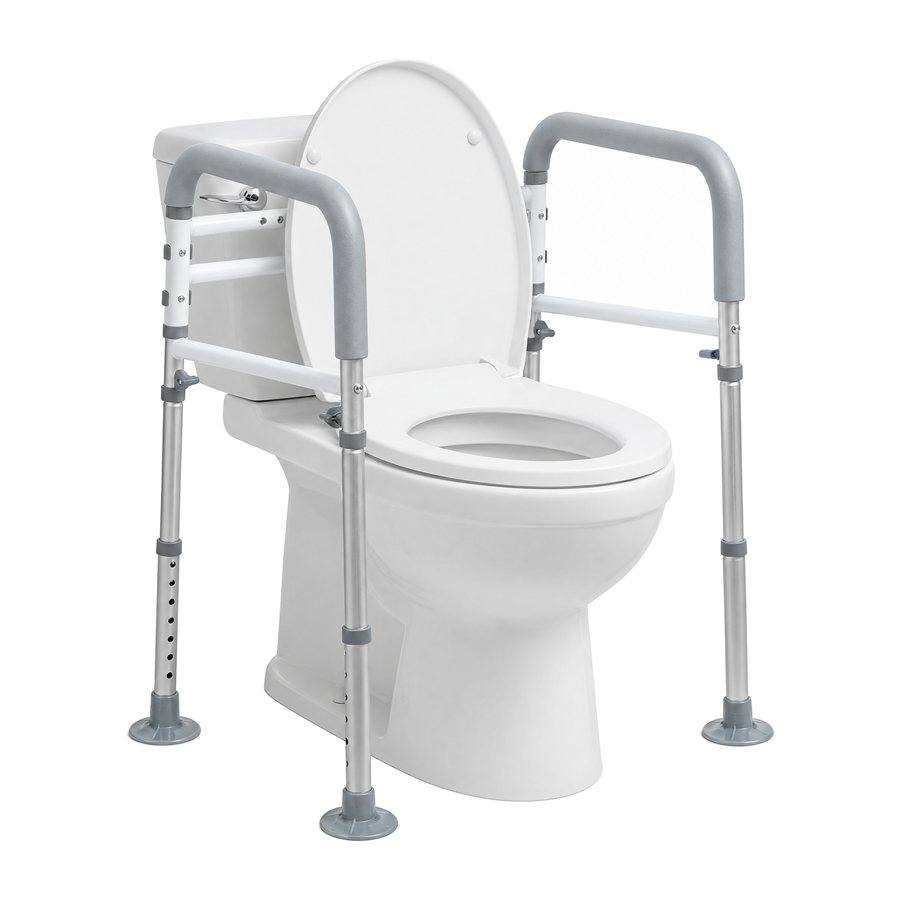
Freestanding, with armrests that adjust in 7 heights. Four suction-cup feet. No tools, no drilling, folds flat.
Sources
- Nonfatal Bathroom Injuries Among Persons Aged ≥15 Years, United States, 2008 (MMWR, CDC, 2011)
- Bathroom safety for adults, MedlinePlus Medical Encyclopedia, U.S. National Library of Medicine
Written by Arman Markar, founder of Abrielder. General information only, not medical advice.
Will a toilet safety rail fit my toilet? · How to set it up at the right height · Toilet safety rail or grab bar? · Bathroom safety for renters